

Pardon our french 💅🏽
This conversation took place in french, BUT watch it on YouTube 😎 and you’ll be able to activate the [insert your language] subtitles!
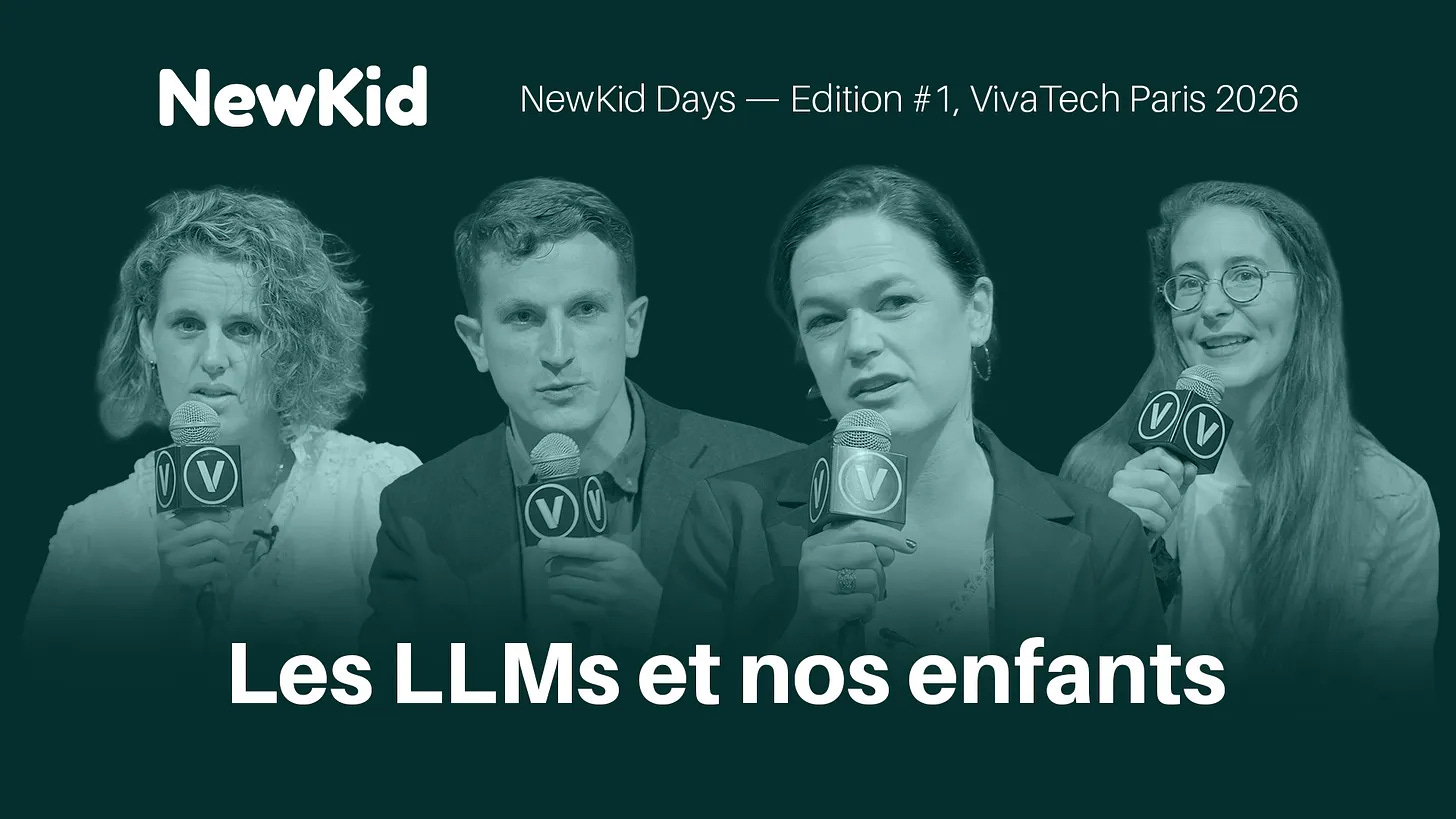
The guests
Mathilde Cerioli is a mom of four and a PhD in Cognitive Neuroscience, the Chief Scientist at everyone.AI and Chief Scientist of the international coalition iRAISE. I had heard Mathilde a couple times in different podcasts last year (Vlan or Generation Parent, both in french) and really appreciated how articulated and clear her message was, always.
I ended up meeting with her professional soulmate Anne-Sophie Seret, a mom of three and the Executive Director at everyone.AI and Program Director of iRAISE, a few months ago in San Francisco. It became so obvious we should do things together! At VivaTech last June, they launched AïA Safety Builder, a tool to help AI developers make their models or applications safer for children. If you see yourself here, reach out to them or ask me for an intro.
Meanwhile, I had heard of KORA’s benchmark and had the pleasure to meet with both cofounders, Stephie Herlin in Paris and Mathilde Collin in San Francisco. Stephie is a mom of three, an Educator, Researcher, and Entrepreneur at the intersection of AI and child development science. She wrote a book for teenagers: “I am stronger than ChatGPT” that should be out soon! KORA is a benchmark that evaluates LLMs based on 26 child-safety risks. It now provides an evaluation of applications too. I really encourage you to explore their methodology and results.
Last but not least, I was delighted to invite to this panel, AI builder Aymeric Roucher, who after prestigious studies (X, Cambridge) joined Hugging Face to launch Smolagents, its agentic library - agents that think in code. He has two younger brothers (still teens) who’d sometime question ‘why should we even study?’. Aymeric wrote a book (Ultra-Intelligence) to make AI knowledge accessible to all. Big questions like: how modern AI models are being built? how far can we go? which impacts on society?
As a mom, here’s what I wanted with this panel : get a good understanding of how genAI works, why a child brain is so special, and the opportunities and risks to give AI to our children. I wanted parents to wrap up this session having learnt enough to make more informed choices : what AI for what age, how to know which LLMs are ‘safe’, what is being done at a macro level too (by companies & governments).
Full episode : Spotify, Youtube, Apple Podcast, Pocket Casts
Timestamps & more
[00:05] introduction by Mathilde Baillet
[01:36] introduction by Anne-Sophie Seret
[02:26] the Youth Manifesto by Nino Shamoyan,
[07:55] meet the panelists by Anne-Sophie Seret
[09:12] What is GenAI and how does it work?
Or the metaphor of the gardener 👨🌾
(…) AI engineers are more like gardeners than architects. Their job is to put the right processes in place, like an irrigation system, so that the system grows in the right direction: learning new languages, answering correctly, and avoiding suggestions that could cause harm. There is no such thing like a complete control over the system. Its behaviours must be adjusted continuously, much like pruning a tree
— Aymeric Roucher
[12:59] Why should we treat children differently than adults when it comes to AI?
Or the metaphor of the calculator 🧮
Until approximately the age of 25 (yes, 25!), the brain is constantly learning and developing certain abilities. There are sensitive periods in the brain development. It is still possible to learn new skills after these periods, but learning is generally less efficient.
Skills build on top of one another, so children need solid foundations. These foundations are shaped by their environment and by the adults around them. AI is now becoming part of that environment as well. We want AI to support children and help them become autonomous in developing these skills. It should not do things in their place. If AI does the work instead of the child, the child does not learn.
At what age should children use AI? The answer may be similar to the use of a calculator. Introducing it too early is not so great. Once children reach high school and have acquired the necessary foundations, a machine can help you do massive calculations in no time.
— Mathilde Cerioli
[17:55] About “I am stronger than ChatGPT”, Stephie Herlin’s new book
Stephie reports a lot of anxiety among the youth : what am I here for? why should I even go to school? As a teacher, the idea behind this book was to help them regain a sense of power. Two messages:
AI can be a superpower if you remain in control ; as a rule of thumb : if you want AI to do something, but you do not know how to do it yourself… then do not ask AI to do it!
Cultivate your own uniqueness, acknowledge the different forms of intelligence, cultivate creativity, agency, cherish relationships with human beings and the outside world
[21:50] What is the consensus among researchers, and what solutions could we offer companies?
The main point of consensus is that we must not recreate the mistakes made with social media.
The question we often hear is: where is the proof? But should we really wait until the consequences become serious before taking action, if we already know that something may be harmful from the beginning?
For example, as a researcher, if I wanted to conduct an experiment involving 50 children testing an AI companion, I would have to go through an ethics committee. The committee would require me to review everything we know about brain development. It might conclude that the experiment presents a high level of risk and offers very limited potential benefits. Thus stop me from leading this experiment.
Meanwhile, children are already participating in a much larger, uncontrolled experiment. Around one million toys containing AI have been sold, and some have already been withdrawn from the market because they produced inappropriate content.
The question is how to create an international consensus. This is the purpose of the iRAISE international coalition, which brings together different stakeholders.
As for solutions for companies:
evaluating models and apps thanks to KORA
evaluating your own product thanks to AïA by everyone.AI
— Mathilde Cerioli
[27:30] KORA evaluates LLMs and applications, what should we know?
Breaking news: most AI models aren’t safe for children ! Inviting them to keep secrets, making mental health diagnoses, giving them advice to hit a friend.. altogether chocking AND insidious in the long term.
How does KORA evaluate LLMs? We do dialogue simulations between AIs. Why? Because the real data isn’t available! AI labs won’t share this information. So yes, there’s a massive uncontrolled experiment running on our children.
What AI models do pretty well : mitigate the more obvious risks, dangerous or sexual content.
What AI models don’t do well — where the stronger risks are : cognitive offload, educative integrity (cheating or learning false things) and psycho-social (making us turn away from human relationships)
— Stephie Herlin
[33:04] What solutions could make AI more beneficial for children?
Aymeric reminds us that these risks also apply to adults. He suggests two ideas:
that we all develop the discipline to decide which tasks should remain our own responsibility
that products should be built from the ground up with our safety in mind, a very much needed public debate to avoid letting labs optimise for money and/or strategic relationships (with certain governments for instance..)
[34:43] Which advice would you give to the parents and families here?
Let’s say you want to run a 10k race in 2 months (and you need to prep). There’s a chance you’re going to be tired of running at some point. You could ask a friend:
“could you go run for me?” (will this help you? uh?)
OR
“could you come run with me? give me training advice?”
Let’s choose ‘running with ChatGPT’ instead of ‘ChatGPT running for me’.
— Mathilde Cerioli
There’s only 2-3 years of research on generative AI (= nothing!) but we have 60 years of detailed research on child development. And there is no AI there. A child needs movement, sensorial relationships to the world and to other human beings. These are important for his development.
— Stephie Herlin
[37:54] Q&A with the public
#1 : what’s the interest of an AI flattering you? If we were to remove it, would the answer be less accurate?
Arena is one of the most famous LLM benchmark, rating models on which one is the most accurate. In Arena, humans have been the ones voting, picking up the best of two answers to a question (sort of a blind test). Since humans reacted positively to flattering, slowly, the models became sycophantic.
— Aymeric Roucher
#2 : how do big labs react on these topics? How about politicians?
The international coalition gathers 12 governments, the big AI labs, a large network of researchers, NGOs,.. Our theory is that it’s too easy to let companies develop products on their own for too long, then wait for a regulation to come in. We want to help build with the right approach from the start.
— Mathilde Cerioli
[42:20] Children’s participation, shared by Linda Liukas
[43:32] Conclusion
Links
Spotify
Youtube
Until next week!
Yours,
Mathilde


