

hello!
I’ve been absorbed in two things lately, a never-ending “inbound” of articles and podcasts (I made a selection for you below), as well as meeting new folks at an exponential pace for the Paris event I am preparing: “Parenting and Education in this AI era”. It is thrilling and I’ll tell you more below!
OK, on to the favorite content I digested lately:
tl;dr
what’s left for human beings in this AI world? and the role of education - and teachers - in that matter
meet the critical thinking bot that helps you sharpen your arguments
ever heard about the “algorithmic agnotology” framework?
slice of my parenting journey 👋
should we keep drawing cringe animals for our kids, or outsource this to an AI?
are you on the self-served dictionary team or need-parent AI bot team - or a mix of both - when it comes to your child seeking knowledge?
what’s left for human beings in this AI world : the crucial role of education
The Displacement of Purpose is the best article I’ve read recently and that I discovered in the excellent Dense Discovery newsletter.
The author, Peter Adam Boeckel, claims that in a world driven by three simple principles - speed, time and money - AI is not a curse but a “dream come true”. When AI fully performs most of our work, what is left for us to mean?
Education might be the guardian of our humanity, though will have to radically evolve when knowledge is free and purpose no longer found in employment.
***
A few snapshots to tease you a bit (but really, read the full article):
The response must begin where all transformation begins: in education. If work once taught us rhythm, learning must now teach us coherence. The systems we build to instruct the next generation will determine whether the age of hyperautomation leads to collapse—or evolution.
…
If automation dismantles the architecture of work, education must become the architecture of meaning. The challenge is no longer how to prepare people for jobs that may soon vanish, but how to prepare them for a life where purpose is not delivered by employment. The future classroom will not exist to transmit knowledge but to cultivate orientation—to teach people how to stay coherent as the ground beneath them shifts.
…
Critical thinking, creativity, and emotional intelligence—once considered supplementary—will become the new core curriculum. Yet even these are not ends in themselves; they are the training ground for something deeper: the capacity to stay human in an increasingly synthetic world.
…
When knowledge is free, presence becomes priceless. And perhaps that is the paradoxical gift of automation: by taking over everything that can be taught without us, it forces us to rediscover the things that can only be learned together.
…
The next generation will not ask, “Where did you study?” but “From whom did you learn?”
…
The role of the teacher will shift from dispenser of truth to curator of experience—to hold the space where insight might occur.
the critical thinking bot…
Shae O. is one of my favorite writers these days. She’s obsessed with helping humans cultivate agency and critical thinking in the age of AI. She has developed the Critical Thinking Bot, a free tool to help you play with your thoughts:
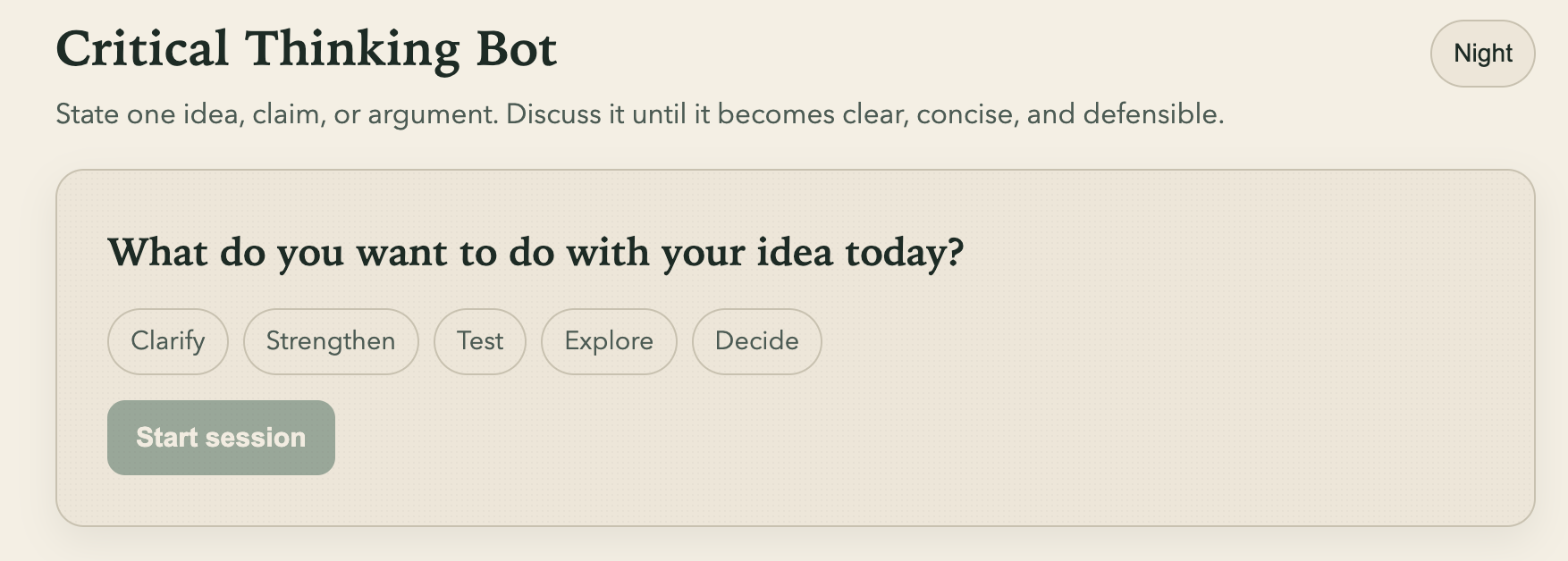
… and the algorithmic agnotology playbook
Shae recently attended the International Association for Safe & Ethical AI summit in Paris, and generously shared a 17min resume here. She reports a thought-provoking concept called the “algorithmic agnotology” playbook. According to some, a game of power played by the AI labs?
fyi, agnotology is the study of (the deliberate production of) ignorance.
It consists of 3 core mechanisms:
design opacity (the undisclosed training data) as a shield against accountability
generated uncertainty (hallucinations are due to AI systems being deployed before they’re ready), that positions the companies as both the problem creator and the only solution
claims of unknowability : big tech playing the game of either epistemic uncertainty (= we don’t know yet but we could with more time, research,..) when seeking investment, or stochastic uncertainty (= the system is fundamentally probabilistic) when facing accountability
Inscrutability is a choice, not a necessity. And this is a power problem.
Are we interrogating opacity or are we legitimising it? - Dr A. Nelson
I invite you to hear Shae’s recap of day 1 too (about “a race that nobody actually agreed to run”), and follow her work on Substack and Youtube.
✨ The NewKid Days ✨
1st edition : Paris, June 2026 [dates tbc]
What is it? A pause in the tumult. Two distinct moments to question, think and connect around the most important topic of our time : how do we raise the next generation of human beings in this AI era?
Also, here’s how you can help:
📌 who is the most passionate, insightful person you’ve heard on that topic, that should absolutely participate as a speaker? whether they’re in France or not
📌 know any specific foundations or companies looking to support this movement? (either as their core mission or for employer branding purposes)
Merci! I am so beyond excited to get this in motion!! Stay tuned.
Parenting in 2026
keep drawing?
I don’t know about you, but this week again, I’ve been asked ordered to draw characters in a homemade colouring book. Because ‘all colouring books are lame’, and because ‘we suck at drawing’ (and you don’t, mum). While the later could absolutely be discussed, here I am, inventing wild animals for them to colour.


Meanwhile, I came across this new tool that consists of prompting a box out-loud and it instantly prints a sticker ready to be coloured. Fantastic, right?
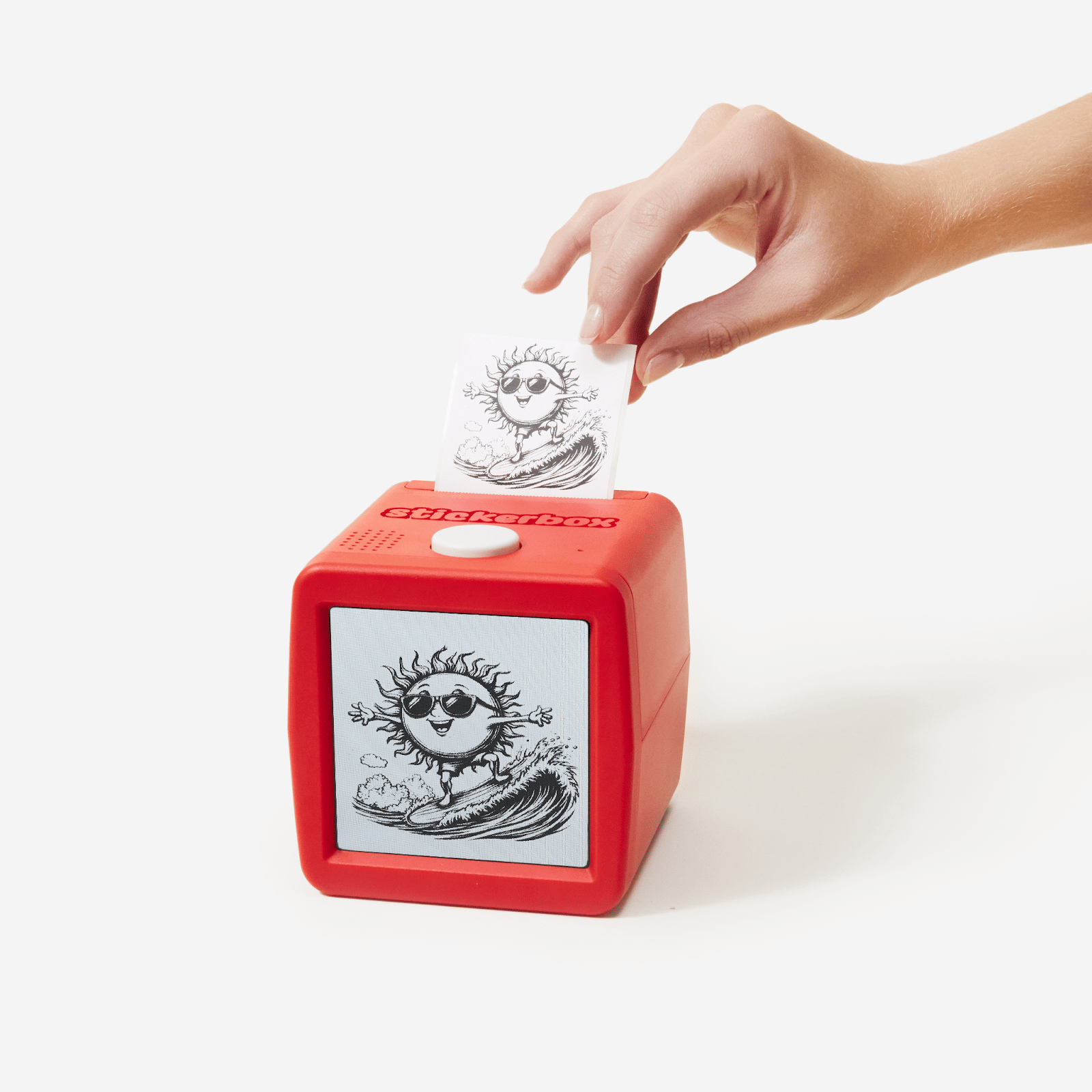
Stickerbox is the AI for kids that doesn’t talk back. Its founders claim that AI should be designed for kids from scratch, instead of built-for-adult first, like most AI toys today, consisting of “wrapping ChatGPT in fur.”
While I must admit this idea-to-sticker-in-a-second is pretty irresistible, I can’t help but wonder: what learning opportunity are we taking from them, as we hand over this apparently harmless toy? (it only listens when the top button is pressed)
drawing skills => if you can press and prompt, instead of sitting down with your pen and your imagination, how will you improve your drawing over time? (And should we even care about this at all? I am drawing for them now, after all.)
precise intentions => maybe the child had a really sharp idea of what they wanted to draw, but the AI doesn’t get it, it has its own biaises. Should they accept and conform? Prompt better? Leave the box behind and embrace the fuzzy attempts to make their hand clumsily draw the exact thing that was in their mind, at all cost?
relationship => the need, expressed by my child, for me to come and sit next to him. Cause maybe, the drawing is just an excuse for bonding, and I am not seeing this.
What should we celebrate as parents? The imperfect drawing? And the following, slightly better versions? The accurate vocabulary used to prompt? Them refining their prompting skills, one attempt after the other?
I am growing convinced that we should celebrate friction more. I also know that if we adults do not embody it, well, good luck passing it down to the kids.
What I can see here though, is yet another tool to remove friction - for the child, and let’s be honest, for the parent, too.
What do you think?
Le Robert vs Perplexity
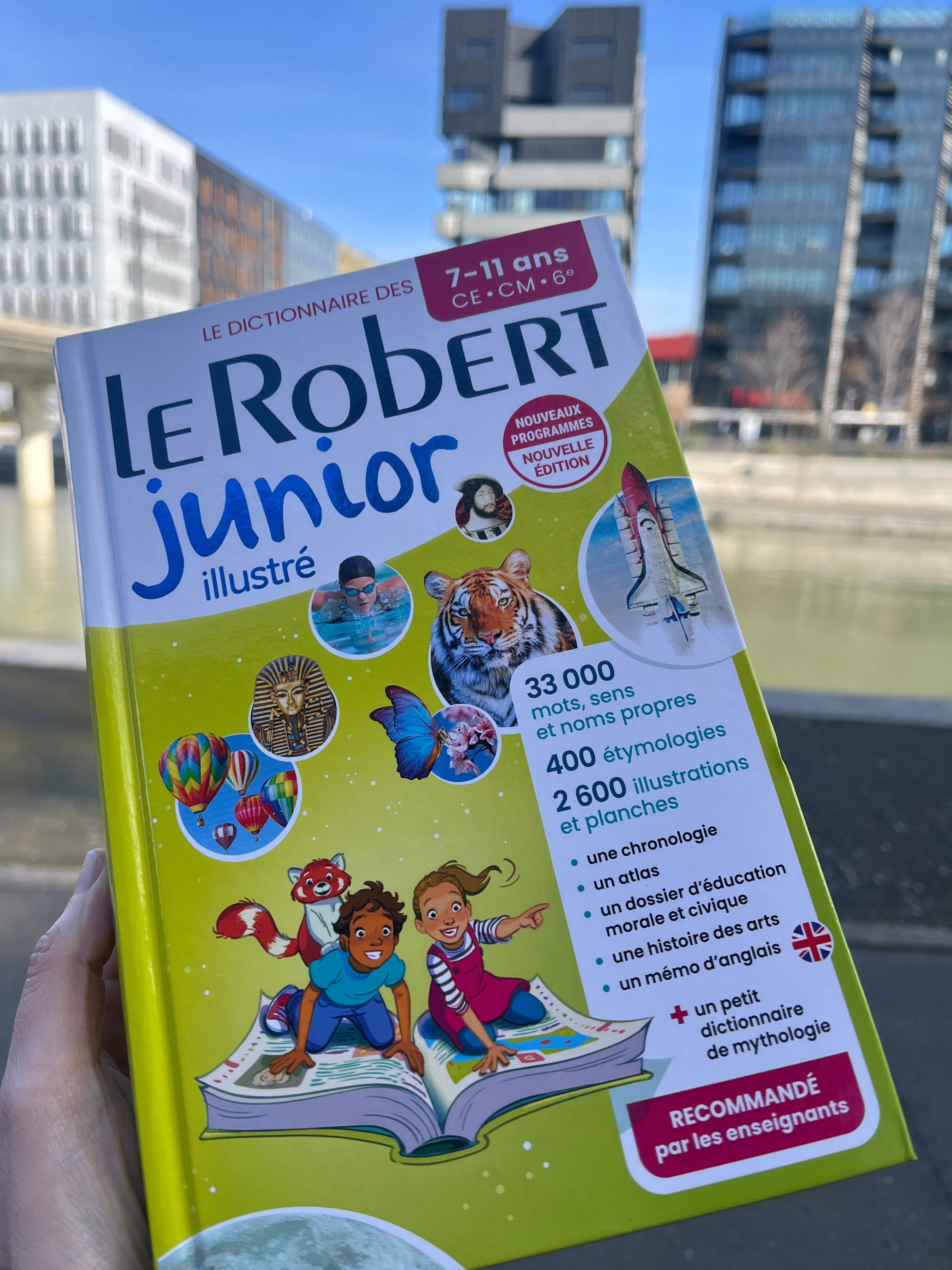
Last week, we bought our kids a dictionary.
Who cares, right? Well, our kids probably. Their growing sense of autonomy. Starting now, they will be able to look up through the 1532 analog pages of this huge book full of words to decipher, instead of asking us to get our phone and ‘ask Perplexity, she knows’.
Our 7 y/o son’s teacher actually raised the point when she asked me and Kev, during our quarterly meeting “he absolutely loves to go check the dictionary, I bet he does the same at home”. Ah? We looked at each other, confused.
I could shame ourselves but what’s the point. We’ve moved in and out so often in our lives that clearly, a 3kg book which content you can find online in a second didn’t make any sense to carry around.
Now it’s different. Both our children can read. Both are old enough to go seek information on their own. Welcome home, Le Robert Junior 🥂
Bonus : toys rebelling against AI companions
Get ready for Toy Story 5, mid June, where Bonnie meets Lilypad, the AI friend. And disposes the good ol’ toys. If the concern isn’t here already, what is it?
Yours,
Mathilde